Data Cataloging, Metadata & Lineage
A data catalog is not a documentation project — it is the operational backbone that makes ML models auditable, reproducible, and debuggable. Teams that skip cataloging discover its necessity the hard way: a model regression they cannot root-cause, a compliance audit they cannot pass, or a critical dataset deletion they cannot undo.
Without metadata, data is just bytes. Without lineage, a model is just a black box that nobody can audit, debug, or trust.
Why this matters
An ML team at a large e-commerce company spent three weeks debugging a 12% AUC regression in their recommendation model. The model had degraded after a routine retraining. They suspected a data pipeline change. But with no lineage tracking and no data versioning catalog, they had no way to answer the question directly: which dataset version trained the current model vs. the previous model?
They spent three weeks replaying six months of pipeline execution logs, cross-referencing job timestamps with S3 object creation times, reading Confluence pages that were two years out of date. They eventually found it: a single upstream ETL job had quietly changed the null-handling behavior for a high-cardinality categorical feature. A three-week debugging exercise that should have taken three hours.
The root cause was not the pipeline bug. The root cause was the absence of a data catalog.
A data catalog is the operational layer that transforms a collection of datasets into a governable, discoverable, reproducible ML data infrastructure. It answers four questions that every production ML team is eventually forced to answer under pressure:
- What datasets exist, and what do they contain? (Discoverability)
- Where did this data come from, and how was it transformed? (Lineage)
- Which models, pipelines, and dashboards depend on this dataset? (Impact analysis)
- Is this data trustworthy for the use case I have in mind? (Quality and governance)
Teams that answer these questions with tribal knowledge (asking the one engineer who has been around the longest) eventually discover that engineers leave. Tribal knowledge evaporates. The catalog does not.
The four layers of a data catalog
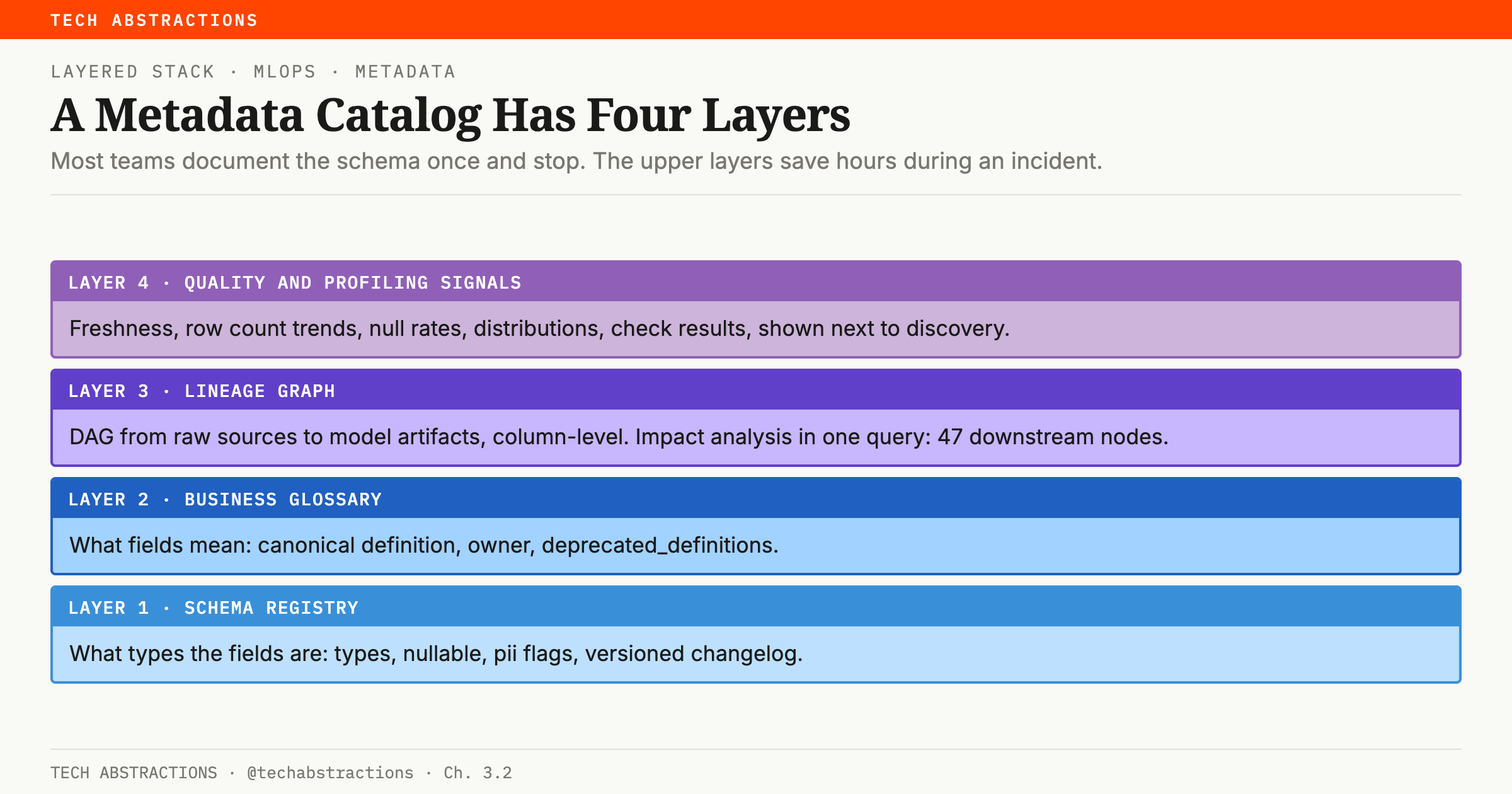
A data catalog is not a single thing. It is four cooperating layers, each answering a different category of question.
Layer 1: Schema registry. The authoritative definition of what fields exist in every dataset: names, types, nullability constraints, and schema version. For ML, the schema registry enforces contracts (pipeline code validated against the registered schema before execution), detects breaking changes (field renames trigger impact analysis), and enables reproducibility (training jobs pin to a specific schema version).
A schema registry entry for ShopSense's user_events dataset tracks field-level metadata including PII classification, nullable constraints, allowed values, and a changelog with breaking: true flags for field renames. Without the breaking change flag, downstream consumers silently receive null values for renamed fields and never get a notification.
dataset: user_events
version: 3.2.1
fields:
  - name: user_id
    type: string
    nullable: false
    pii: false
  - name: event_type
    type: string
    nullable: false
    allowed_values: [view, click, add_to_cart, purchase, search]
    pii: false
  - name: product_id
    type: string
    nullable: true   # null for search events
    pii: false
  - name: event_timestamp
    type: timestamp_utc
    nullable: false
    pii: false
  - name: user_ip_address
    type: string
    nullable: true
    pii: true        # GDPR-relevant: requires access control
    retention_days: 90
changelog:
  3.2.1:
    date: 2024-11-15
    change: "added user_ip_address field for geo-feature development"
    breaking: false
  3.2.0:
    date: 2024-09-01
    change: "renamed product_clicked to product_id for consistency"
    breaking: true
    migration: "consumers must update field reference from product_clicked to product_id"
Layer 2: Business glossary. The schema registry answers "what types are the fields." The business glossary answers "what do they mean." In a 100-person data org, the term "active user" means different things to the growth team (logged in within 30 days), the recommendation team (placed an order within 7 days), and the finance team (revenue-generating within the billing cycle). When a training dataset is built using one team's definition and evaluated using another's, the offline metrics look better than production performance, not because the model is wrong, but because the evaluation set was constructed from a different population.
A business glossary entry includes a canonical definition with a computation, an owner, a deprecated_definitions section, and cross-references to related terms. The deprecated definitions field answers: why did this metric change after last quarter's infrastructure migration?
Layer 3 (Lineage graph). The directed acyclic graph of transformations connecting raw data sources to ML model artifacts. Complete lineage shows column-level mappings (which raw fields flow into each derived feature), pipeline provenance (which ETL jobs produced each version), and model consumption (which training dataset trained each model version).
Column-level lineage makes impact analysis tractable. When event_timestamp in user_events has a timezone offset bug, the lineage graph answers which downstream features were affected (47 nodes at ShopSense's scale) in a single graph query. Without lineage, it is a multi-day manual audit.
Layer 4 (Quality and profiling signals). Freshness, row count trends, null rates, distribution statistics, and data quality check results surfaced alongside discovery information, so data consumers can evaluate trustworthiness before building a pipeline on top of a dataset.
Think About It: What does ShopSense's user_session_features catalog entry need to capture?
You are the data platform engineer responsible for cataloging ShopSense's user_session_features dataset. This is a derived feature table built from user_events and consumed by the recommendation model and the search ranker.
The table has these fields: user_id, session_id, session_start_ts, session_duration_seconds, page_views_count, products_clicked, searches_performed, session_date.
Work through these questions before reading on:
-
Schema registry: Which fields should have
pii: true? Which fields should be nullable? What would you put in the changelog if you changedsession_duration_secondsfrominttofloat? Is that a breaking change? -
Business glossary: The term "session" is ambiguous. The product team defines it as "any web activity within a 30-minute idle window." The ML team defines it as "the period between login and logout." Write a canonical definition that would be acceptable to both, and note what you'd put in
deprecated_definitions. -
Lineage: If a new ML team wants to train a model on
page_views_count, what upstream columns does that feature trace back to inuser_events? Write the lineage path as a chain. -
Quality signals: What three quality checks would you configure as automated monitors for this table? What would each check catch?
Why this matters: The exercises above are the four catalog layers applied to a single dataset. Most ML teams document once (the schema) and stop. The business glossary and lineage entries are the ones that save hours when an incident happens.
Three generations of metadata architecture
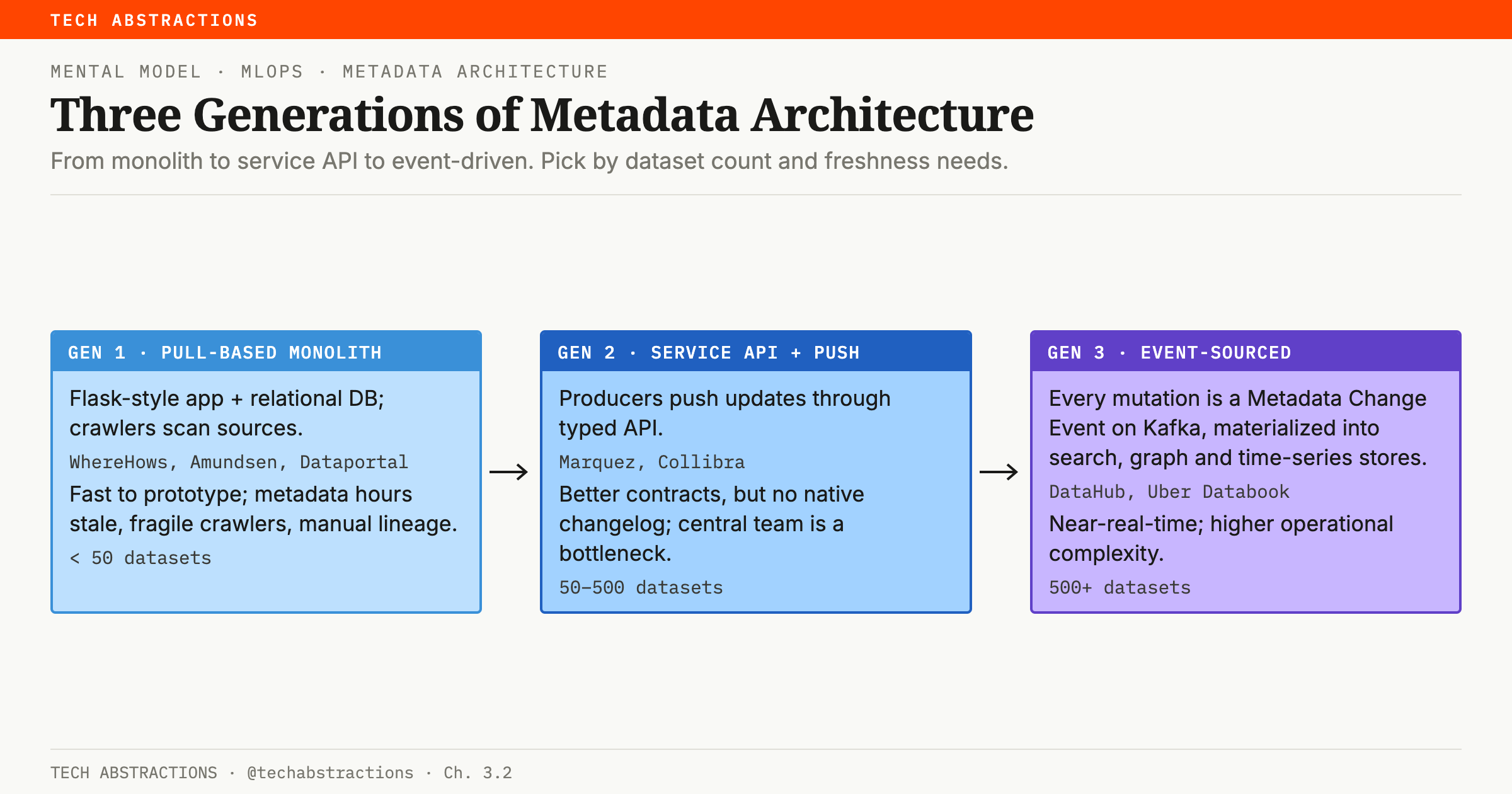
The way metadata is collected and stored follows a historical pattern: from monolith to service API to event-driven.
Generation 1: Pull-based monolith. A Flask-style web app backed by a relational database, with metadata collected by crawlers that periodically scan data sources. Examples: original WhereHows (LinkedIn), Lyft Amundsen (initial version), Airbnb Dataportal. Fast to prototype, but metadata is hours stale, crawlers are fragile, and lineage requires manual entry. Appropriate for < 50 datasets.
Generation 2: Service API with push capability. A service layer allows data producers to push metadata updates via API. Examples: evolved WhereHows, Marquez, commercial tools like Collibra. Better contracts via typed interfaces, but still no native changelog. The central API team is a bottleneck for model evolution. Appropriate for 50–500 datasets.
Generation 3: Event-sourced, stream-first. Metadata is treated as a stream of events. Every mutation generates a Metadata Change Event (MCE) published to Kafka. Downstream consumers materialize these events into specialized stores: Elasticsearch for search, a graph database for lineage, a time-series store for quality trends. Examples: LinkedIn DataHub, Uber Databook. Near-real-time freshness, reliable index bootstrapping. Higher operational complexity. Appropriate for 500+ datasets with freshness or governance requirements.
Think About It: Which generation of metadata architecture should ShopSense use today?
ShopSense currently has:
- ~200 datasets cataloged (or not cataloged) across 4 storage backends: Hive/HDFS, S3, RDS (PostgreSQL), and a Redis online store
- 20 ML engineers
- Payment transaction data that requires GDPR compliance
- 5 models in production, 3 in development
- No existing catalog infrastructure
Work through this before reading on:
-
ShopSense's payment data triggers GDPR compliance obligations. Does this automatically push them toward Generation 3? Or is there a simpler path to compliance?
-
With 200 datasets, ShopSense sits in the middle of the Generation 2 range (50–500 datasets), well below the Generation 3 threshold (500+). What would tip the decision toward Generation 3 vs. staying at Generation 2?
-
If ShopSense started with a Generation 1 catalog today (fast to build), what would be the migration path to Generation 2 when they hit the scale limit? What would they need to preserve or rebuild?
-
A colleague argues: "We should skip Generation 1 and 2 and go straight to DataHub; we'll need it eventually anyway." What's your response? Under what conditions would this argument be correct?
Consider: The generation framework is descriptive, not prescriptive. Real production decisions involve team capacity, time-to-value, and migration costs, not just scale.
Industry deep-dive: LinkedIn DataHub
LinkedIn's DataHub is the most widely cited example of Generation 3 metadata architecture (Das et al., LinkedIn Engineering Blog 2019), now open-sourced as the foundation for the datahub-project ecosystem.
The problem: LinkedIn's original catalog, WhereHows, was a Generation 1 pull-based system that failed at scale. Metadata was hours stale, the central team was a bottleneck for adding new entity types, and downstream governance tools couldn't subscribe to changes.
The core insight from Shirshanka Das: "General is better than specific." Where WhereHows was built specifically for datasets, DataHub was designed to catalog any entity (datasets, ML features, models, pipelines, users, dashboards) without requiring platform team support for each new type.
The architecture:
- MCE/MAE pattern: Every metadata mutation generates a typed Metadata Change Event (MCE) published to Kafka. After validation, a Metadata Audit Event (MAE) is emitted , the canonical confirmation a change is committed. Downstream consumers subscribe to MAEs. (Since DataHub v0.8.7 these streams have been generalized into per-aspect Metadata Change Proposals (MCPs) and Metadata Change Logs (MCLs); MCE/MAE describes the original design.)
- Aspect model: Each entity has a core URN identity and multiple independent aspects (
SchemaMetadata,Ownership,DatasetProfile). Each aspect is updated independently by the team that owns it. - Impact analysis via graph: The query "what would break if I rename this column?" is a graph traversal from the affected column node to all downstream consumers.
Key lessons:
- Push beats pull: pipeline-emitted MCEs are reliable; crawlers are operationally fragile
- Treat metadata mutations as an append-only log: enables index repair, time-travel queries, audit trails
- Model relationships as first-class citizens: lineage cannot be bolted on later
- "Putting metadata to work is harder than just putting metadata together" The investment pays off when metadata drives governance automation
Industry deep-dive: Netflix Metacat
Netflix's Metacat (Netflix Technology Blog, 2018) is a metadata gateway rather than a metadata store: a unified API layer that federates across heterogeneous storage backends: Hive, S3, RDS, Druid, Redshift, and Iceberg, presenting them as a single logical warehouse.
Canonical data types. Metacat maps BIGINT in Hive, INT8 in Postgres, and NUMERIC(19,0) in Redshift all to the canonical type LONG. For ML, this prevents a silent failure: a training pipeline reading from Hive sees FLOAT for purchase_amount, but the serving pipeline reading from RDS sees DOUBLE. The feature computation results differ due to floating-point precision.
The operational/interpretive separation. Netflix's most exportable architectural insight:
- Operational metadata (automated, low-latency): schema, partition keys, file locations, record counts, freshness. Emitted automatically by pipelines. Used by compute engines for query planning and monitoring for freshness violations.
- Interpretive metadata (human-curated, eventually consistent): business descriptions, ownership, PII tags, quality notes. Contributed by humans.
Conflating these categories produces systems where business descriptions are held to the same freshness SLA as partition counts, operational alerts for human-authored content that changes slowly by design.
Industry deep-dive: Uber Databook
Uber's Databook (Uber Engineering Blog, 2018) organizes metadata discovery around three user intents: Discover, Understand, Manage.
Dragon: standardized metadata vocabulary. When the training team wants to add a new metadata field (e.g., training_data_start_date), they define it in Dragon, Uber's metadata schema definition language. Dragon schemas are version-controlled and reviewed before any producer emits the new field. Without Dragon, metadata fields proliferate with incompatible semantics: training_cutoff as Unix timestamp, data_end_date as ISO string, training_data_until as epoch day, none comparable programmatically.
Graph-based relationship modeling. Every relationship is an explicit edge in a property graph: training dataset → upstream feature tables (lineage), ETL pipeline (provenance), model versions (consumption), downstream serving systems (impact). When monitoring detects distribution shift, the graph answers: which pipeline produced the training data, and what changed in the past 30 days?
Industry deep-dive: Facebook Nemo
Facebook's Nemo (Facebook Engineering, 2020) focused on making discovery search and ranking work well for engineers rather than on building rich catalog infrastructure.
At Facebook's scale, the bottleneck is not data availability but relevance. A broad search (say, for "user engagement features") can return hundreds of results. Nemo uses a gradient-boosted decision tree (GBDT) in a post-ranking phase, alongside heuristic usage and freshness signals, personalization by role and team, and data quality and lineage information.
Nemo also integrates with Facebook's privacy infrastructure to filter search results by access level. A data scientist without PII access cannot discover PII-tagged datasets in search results, which prevents enumeration attacks where employees guess PII dataset names.
Think About It: DataHub-style infrastructure vs. Nemo-style ranking: what does ShopSense need?
DataHub (LinkedIn) and Nemo (Facebook) represent two different philosophies:
- DataHub approach: Rich infrastructure investment: event-sourced metadata store, graph database, near-real-time lineage tracking. High operational cost, high long-term value.
- Nemo approach: Smart search ranking using GBDT on usage signals, team proximity, and quality indicators. Relatively lightweight, but assumes the underlying metadata is already good enough to rank.
For ShopSense at its current scale (20 engineers, 200 datasets, 5 production models):
-
If ShopSense's primary pain point is engineers can't find the right feature table when starting a new model, which approach addresses this more directly? Why?
-
If ShopSense's primary pain point is we can't explain which data trained a model when a compliance audit comes in, which approach addresses this? Why?
-
Nemo's GBDT ranking model uses "team proximity" as a feature: datasets frequently used by the searcher's team rank higher. What would this mean for a new ML team joining ShopSense? What failure mode does this create?
-
DataHub requires Kafka + Elasticsearch + graph DB. If ShopSense has 2 platform engineers and needs to ship a catalog MVP in 6 weeks, which approach is more realistic? What would you sacrifice?
The core tension: The approach you can build in 6 weeks is rarely the approach you need in 2 years. Good infrastructure decisions anticipate this gap.
Column-level lineage: practical implementation
Column-level lineage is the most valuable lineage tier for ML teams but also the most expensive to implement. Three approaches:
1. SQL AST (abstract syntax tree) parsing (automatic, approximate). SQL-parsing tools (for example OpenLineage's SQL parser, SQLGlot, or sqllineage) infer column mappings from the query text. Works well for SELECT/WHERE/GROUP BY transforms but fails on Python UDFs, PySpark transforms, and dynamic SQL.
2. Explicit lineage emission (accurate, requires discipline). Pipeline code explicitly emits column lineage:
from catalog import ColumnLineage, emit_lineage

def compute_purchase_velocity(events_df: pd.DataFrame, as_of: pd.Timestamp) -> pd.DataFrame:
    window_start = as_of - pd.Timedelta(days=7)
    result = (
        events_df
        .query("event_type == 'purchase' and @window_start <= event_timestamp < @as_of")
        .groupby("user_id")
        .agg(velocity_7d=("event_timestamp", "count"))
        .reset_index()
    )

    emit_lineage(ColumnLineage(
        output_dataset="user_purchase_velocity_7d",
        output_column="velocity_7d",
        input_columns=[
            ("user_events", "event_type"),
            ("user_events", "event_timestamp"),
            ("user_events", "user_id"),
        ],
        transform_type="aggregate_count_filter",
        filter_predicate="event_type = 'purchase', trailing 7d window",
    ))

    return result
3. OpenLineage standard (emerging, interoperable). A vendor-neutral standard for pipeline lineage events with integrations for Airflow, Spark, dbt, and Flink. A ColumnLineageDatasetFacet emitted by an Airflow DAG and a dbt model can both be consumed by the same catalog (Marquez, DataHub). This is the direction production ML platforms are converging toward.
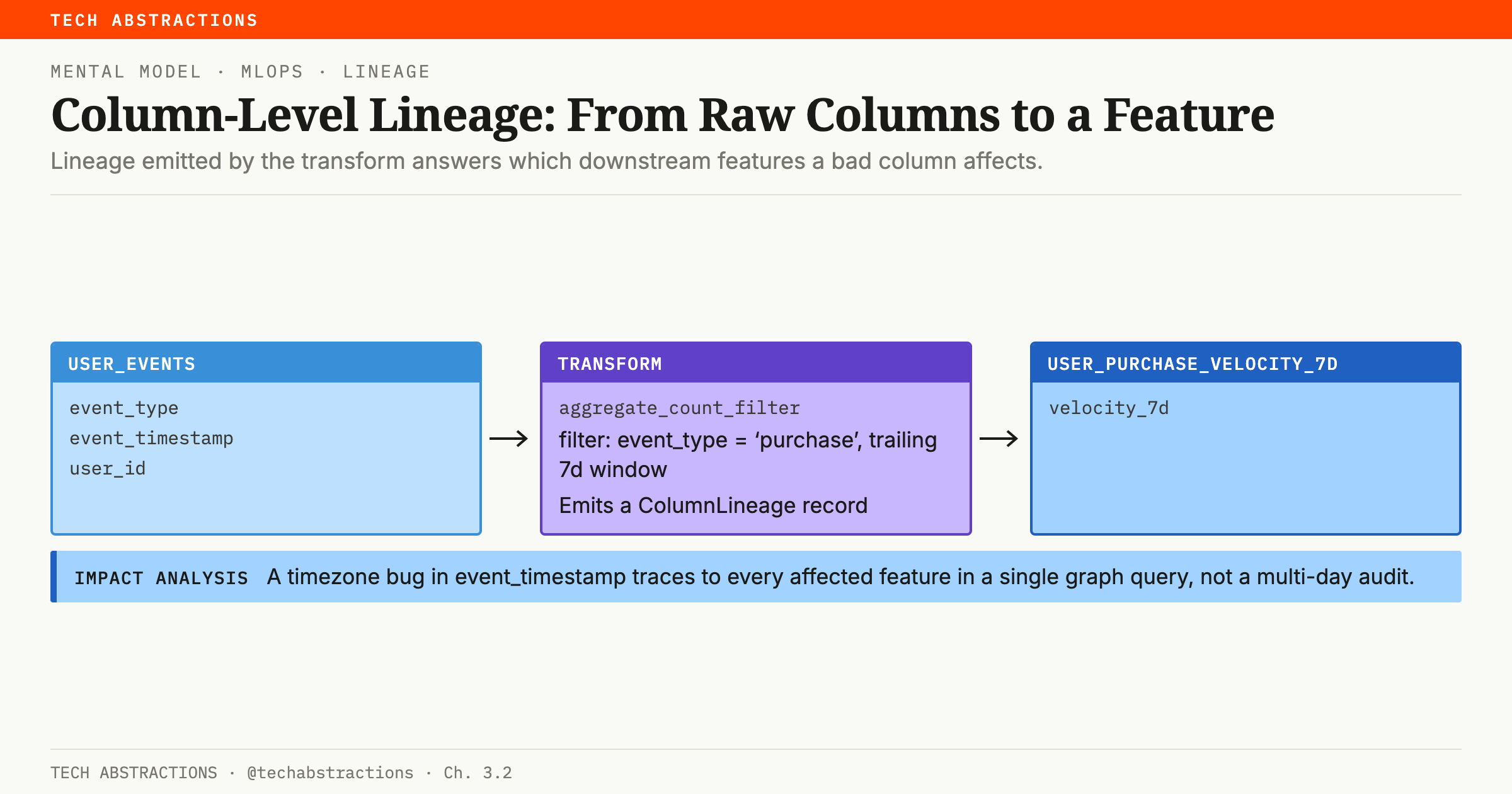
Automated impact analysis. When a data producer proposes renaming product_category to category_primary, the catalog generates a breaking change report before the change ships: 7 direct consumers, 3 model versions affected, 4 teams to coordinate with. Silent breaking change becomes planned migration.
Metadata as a governance artifact
PII tracking and GDPR compliance. Every PII-containing dataset must have field-level annotations, legal basis for processing, retention schedules, and access control policies. When a user exercises GDPR right-to-erasure, the catalog enables automated deletion across all datasets containing their user_id, including derived feature tables and training snapshots. The same workflow handles 1 request or 100,000.
Model audit trails. Every production model version must have a traceable lineage to its training dataset version (content hash), feature view versions, upstream schema versions, training code commit, and approval chain. For regulated industries, this is a legal requirement; for enterprise customers, it is an expectation.
model_version: recommendation-v4
deployed_at: 2024-11-14T09:32:00Z
deployed_by: ml-team-prod-deploy
approved_by: jane.smith@shopsense.com
training_data:
  dataset: user_events_training_snapshot
  version_hash: sha256:a3b8c91f...
  date_range: 2024-09-01 to 2024-11-01
  schema_version: user_events@3.2.0
feature_views:
  - user_purchase_velocity_7d@v2.1
  - item_category_embedding@v1.4
offline_metrics:
  recall_at_10: 0.087
  ndcg_at_10: 0.142
Data classification and access controls. The catalog is the authoritative source for sensitivity classification (Public → Internal → Confidential → Restricted-PII → Highly Restricted). Access control policies (IAM, Databricks Unity Catalog) are generated from catalog metadata, staying current as datasets are added, reclassified, or deprecated.
Build vs. adopt: a decision framework
Three widely used open-source options:
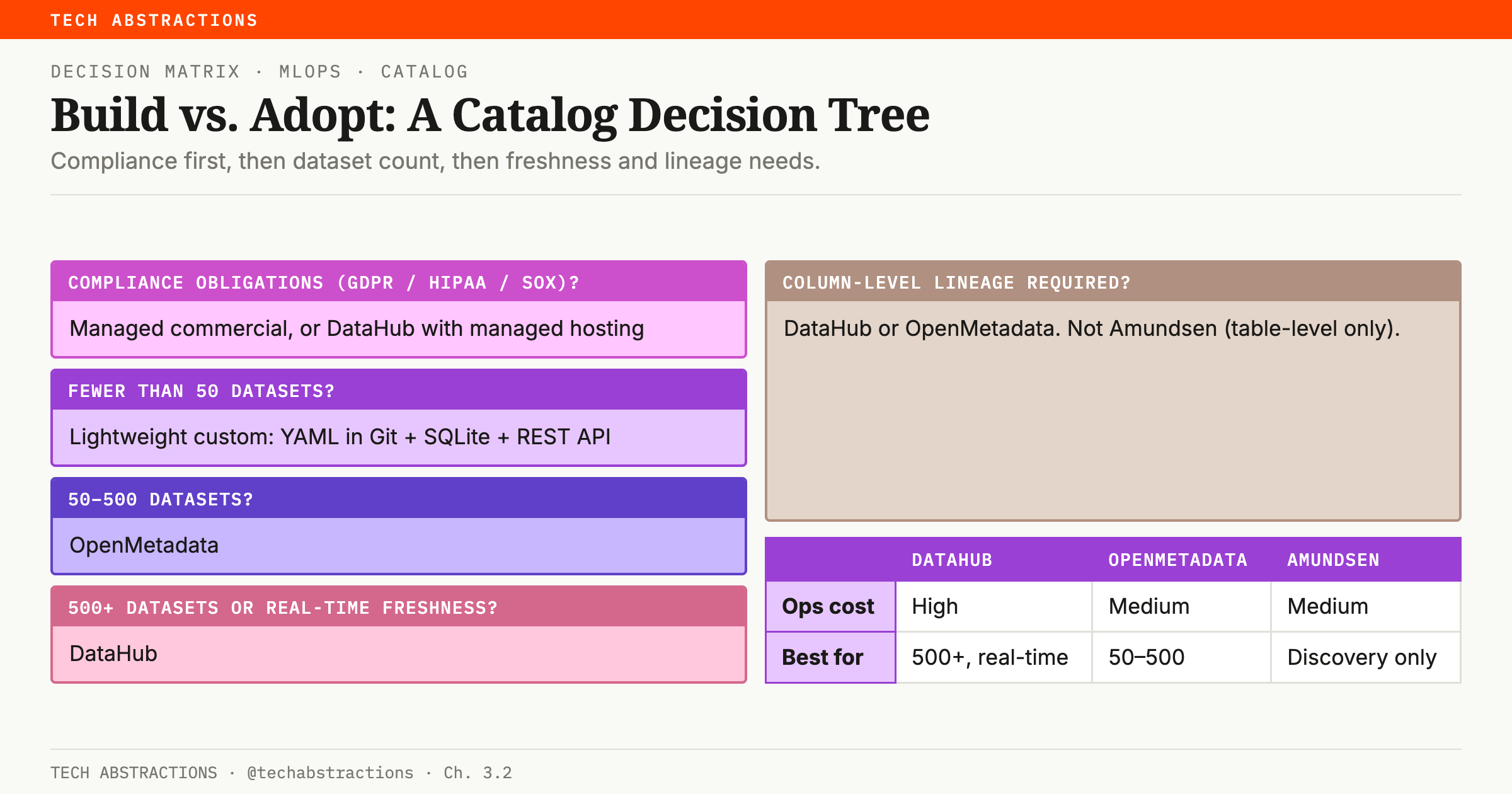
| Feature | DataHub | OpenMetadata | Amundsen |
|---|---|---|---|
| Architecture | Generation 3, event-sourced | Gen 2/3, hybrid | Generation 1/2 |
| Column-level lineage | Yes | Yes | Table-level only |
| ML entity support | Features, models, experiments | Datasets, models | Datasets |
| Operational complexity | High (Kafka + multiple stores) | Medium | Medium |
| Best for | 500+ datasets, real-time freshness | 50–500 datasets, simpler ops | Quick start, discovery-only |
Decision framework:
- Compliance obligations (GDPR/HIPAA/SOX)? → Managed commercial or DataHub with managed hosting
- < 50 datasets? → Lightweight custom (YAML in Git + SQLite + REST API)
- 50–500 datasets? → OpenMetadata
- 500+ datasets or real-time freshness? → DataHub
- Column-level lineage required? → DataHub or OpenMetadata (not Amundsen)
Practical implementation roadmap
Month 1 (Foundation): Catalog the most critical datasets: training datasets for all production models, feature tables they consume, all PII-containing datasets. Minimum entry: owner, schema, freshness SLA, PII fields, location, known issues. A YAML file is better than nothing.
Month 2–3 (Schema registry and lineage): Introduce YAML schema files in Git with validation on merge. Emit column-level lineage for the 5–10 most critical feature pipelines.
Month 3–6 (Catalog platform adoption): Select and deploy OpenMetadata or DataHub. Import existing YAML entries. Configure Airflow, dbt, and Feast integrations.
Month 6+ (Governance automation): Catalog becomes a deployment gate. No training pipeline proceeds without a registered schema version and owner. Access control policies generated from catalog metadata. PII deletion automated via lineage graph.
Key heuristics
- Schema registry before catalog platform. Delivers a large share of the debugging value at a small fraction of the operational cost.
- Column-level lineage must be designed in, not bolted on. Retrofitting typically takes far longer than building it in from the start.
- Operational metadata first, interpretive metadata second. Automate what can be automated before asking humans to write descriptions.
- Catalog the models, not just the datasets. The complete audit trail goes from raw source through features through training data through model versions.
- Push beats pull. Crawlers produce stale catalogs. Pipeline-emitted events produce current ones.
- The catalog's value is backward-looking as much as forward-looking. Lineage and audit trails help production incidents and compliance obligations.
Villain case study: the tribal knowledge failure
Setting: A fast-growing e-commerce ML team, 2022. The recommendation model has performed well for 8 months. Over two weeks in October, precision@10 drops from 0.091 to 0.076, a 16% regression. The model has not been retrained. No code changes pushed to serving.
The investigation: The senior ML engineer begins root cause analysis. No data catalog. No lineage graph. The training dataset is an S3 snapshot from 6 months ago with no version metadata. The original production pipeline was refactored three times since then.
She starts reading Airflow task logs. Eight months of logs for 43 pipeline tasks. Entirely manual.
After 11 days, she finds it: the data engineering team had migrated a product catalog ingestion pipeline from an internal API to a third-party vendor feed 2 months earlier. The vendor feed used a different taxonomy (12 parent categories instead of 47), collapsing the category-encoding feature the model was trained on. Thirty-five of the 47 categories were now mapped to parent categories, destroying the signal.
The cost:
- 11 days of senior ML engineer time
- 2+ months of degraded production metrics before detection
- Estimated $340,000 revenue impact from degraded recommendations
What a catalog would have provided:
- Schema change (47 → 12 categories) logged with
breaking: trueflag - Lineage graph shows
product_categoryflowing into model's training and serving pipelines - Automated impact analysis flags recommendation team as affected consumer
- Time to root cause: 3 hours
Reflection exercise:
-
This incident happened because the data engineering team changed an upstream pipeline without knowing who depended on it. What organizational process, independent of catalog infrastructure, could have partially prevented this? What are the limits of that process at scale?
-
The vendor feed migration reduced category cardinality from 47 to 12. Offline metrics computed on the original training and evaluation data (which still had 47 categories) would not have shown any regression; only live serving inputs changed. Why would this make the regression so hard to detect without lineage tooling?
-
The catalog investment needed to prevent this incident (schema registry + column-level lineage) takes approximately 2–3 months to build. The incident cost $340,000 over 2 months. How would you make the ROI case for catalog infrastructure to an engineering manager who thinks documentation projects are low priority?
Expert analysis: The key architectural gap was the absence of a consumer registry, a component of the lineage graph that answers "who depends on this data?" The vendor feed migration team was acting in good faith; they had no way to know that 3 models and 7 downstream pipelines depended on the internal API's 47-category taxonomy. The organizational fix (requiring a data contract review for any pipeline migration) works at 5 teams; it fails at 20 teams when the process overhead becomes higher than the risk it prevents. Catalog infrastructure scales; process does not.
Case study: LinkedIn DataHub's metadata-driven governance
(Source: Shirshanka Das et al., "DataHub: A generalized metadata search & discovery tool," LinkedIn Engineering Blog, 2019; "DataHub: Popular Metadata Architectures Explained," LinkedIn Engineering, 2020.)
LinkedIn's DataHub team operated at a scale that made the cost of metadata gaps impossible to ignore: more than a million datasets across 23 data storage systems (figures from LinkedIn's 2019 DataHub post). Their original catalog, WhereHows, was a Generation 1 pull-based system. When they rebuilt it as DataHub, they made four architectural decisions that are now widely copied.
Decision 1: Push over pull for metadata ingestion
WhereHows used crawlers that periodically scanned all data sources to collect schema and ownership metadata. At LinkedIn's scale, crawlers caused two problems: they were hours stale (a schema change wouldn't appear until the next crawler run), and they were fragile (any credential rotation or network change could break a crawler silently for hours before anyone noticed the gap).
DataHub replaced crawlers with a push model: when a pipeline job completes, it emits a Metadata Change Event (MCE) to a Kafka topic. The MCE is a typed, schema-validated event containing the entity URN, the type of change, and the new metadata values. A stream processor validates the MCE and emits a Metadata Audit Event (MAE), the confirmation that the change has been committed to the primary store.
Analysis question 1: WhereHows crawled on a 4-hour schedule. A critical table had its user_id field renamed to member_id at 9am. A training pipeline reading from this table ran at 10am and silently started producing null features. The next crawler run was at 1pm. Under the push model with DataHub MCEs, when would the catalog have reflected the field rename? What would the automated impact analysis have shown?
Decision 2: Append-only event log as audit trail
Every MCE in DataHub is appended to a Kafka topic that serves as an immutable log. Unlike a current-state database that only stores the latest version of metadata, the MCE and MAE log stores every change with its timestamp, the system that initiated it, and the before/after values.
This design choice was not primarily about freshness; it was about compliance. LinkedIn operated under multiple data governance regimes. When a compliance audit asked "when was the PII classification added to this field, and who authorized it?", the MCE log answered with a precise timestamp and originating system. A current-state database cannot answer this question.
Analysis question 2: LinkedIn's GDPR deletion workflow queried the lineage graph to identify all datasets containing a user's member_id, then dispatched deletion jobs to each system. After deletion, the workflow wrote a confirmation record to an append-only audit log. Why is the audit log itself a compliance artifact (not just a convenience)? What would a GDPR auditor look for in this log?
Decision 3: Aspect model for extensible metadata
Rather than a fixed schema per entity type, DataHub uses an aspect model. An entity (e.g., a dataset) has a core URN identity and multiple independent aspects that different teams can own and update: SchemaMetadata (owned by the data platform team), Ownership (owned by the dataset owner), DatasetProfile (owned by the data quality team), UpstreamLineage (owned by the pipeline that produced the dataset).
This design means a dataset schema change does not require permission from the ownership team and vice versa. Each team updates their aspect independently, and the DataHub model merges all aspects into a unified view of the entity.
Analysis question 3: Before the aspect model, LinkedIn's central data platform team was a bottleneck: every new type of metadata required them to update the WhereHows schema and deploy a new version. Suppose a team building ML experiment tracking metadata had to wait months for platform team capacity. How does the aspect model eliminate this bottleneck? What governance mechanism replaces the bottleneck to ensure metadata quality doesn't degrade?
Decision 4: "Putting metadata to work"
The DataHub team coined a design principle: "Putting metadata to work is harder than just putting metadata together." A catalog that stores metadata but does not trigger actions from it delivers only discoverability value. DataHub was designed to support metadata-driven automation: when a PII tag is added to a field, access control policies are automatically tightened. When a dataset fails a freshness SLA, downstream training pipelines are automatically blocked. When a model is deployed, an audit trail entry is automatically created.
Analysis question 4: A competing philosophy is "the catalog should be read-only, pipelines should not depend on catalog metadata at runtime." What's the strongest argument for this philosophy? What failure mode does it prevent? What failure mode does it create?
Advanced Exercise 1: Design a complete catalog entry for the ShopSense demand forecasting dataset
(Paid | XP: 40)
ShopSense's demand forecasting model predicts daily inventory requirements for 50M SKUs across 12 regional distribution centers. It is trained weekly on 2 years of historical sales data joined to product catalog metadata.
The training dataset has the following source tables:
sales_events(fields:order_id,product_id,quantity,sale_timestamp,store_id,customer_id)product_catalog(fields:product_id,category_l1,category_l2,brand_id,msrp,weight_kg,is_seasonal)store_metadata(fields:store_id,region_code,store_type,capacity_tier)holiday_calendar(fields:date,is_holiday,holiday_name,country_code)
The training dataset is produced by a weekly Airflow DAG that joins these tables, computes 14 derived features (rolling 7d/30d/90d sales averages, year-over-year ratios, seasonal adjustment factors), and writes a Parquet snapshot to S3.
Your task: Design a complete catalog entry for this training dataset that includes all four catalog layers.
Part A, Schema registry entry (required fields): Write a YAML schema registry entry for the training dataset. Include:
- All 14 derived feature field names, types, nullability, and descriptions
- A
pii: true/falseclassification for each field - A changelog entry for the most recent schema version
- Two fields that you would mark as
breaking: trueon rename, with justification
Part B, Business glossary entry (required terms): Define three terms from the demand forecasting domain that require glossary entries because they are ambiguous across teams:
- A definition for "demand" (the model's target variable): what is the precise operationalization?
- A definition for "seasonal product": is this determined by
is_seasonalflag, by category, by rolling sales variance, or by explicit calendar configuration? - A definition for "effective training cutoff": the last date in the training data, versus the date the training snapshot was created, versus the date the model was deployed
For each term, provide: canonical definition, owner, implementing field, and at least one deprecated definition with the date it was deprecated.
Part C (Column-level lineage path):
Write the complete column-level lineage path for the derived feature rolling_sales_7d from source columns through intermediate computations to the final training dataset field. Include the transformation type and any filter predicates.
Part D (Model audit trail entry):
Write the YAML model audit trail entry for demand-forecasting-v3. Include: training dataset version hash, all upstream schema versions, code commit, deployment approval chain, and three offline metrics. Add a known_limitations field with at least two real issues you'd expect to find in a demand forecasting model trained on 2 years of historical data that includes a one-off demand shock (for example a pandemic-era buying spike or a major supply shortage).
Acceptance criteria:
- Schema registry entry has all required fields, PII classification is correct for all fields
- Business glossary entries include canonical definition, owner, implementing field, and deprecated definition
- Lineage path is traced to specific source columns in specific source tables
- Model audit trail is complete and the
known_limitationsfield reflects real ML issues (distribution shift, out-of-distribution events)
Advanced Exercise 2: Impact analysis: trace the product_category rename
(Paid | XP: 40)
ShopSense's data engineering team has proposed renaming the field product_category to category_primary in the product_catalog dataset. They've submitted a schema change request. As the data platform engineer, you need to produce an impact analysis report before the change ships.
Known facts:
product_catalog.product_categoryis a string field with 47 possible values representing L1 product categories- The rename is motivated by a naming convention standardization effort (all
*_categoryfields will be renamed tocategory_*) - The proposed migration timeline is 2 weeks
The lineage graph (partial) for product_catalog.product_category:
product_catalog.product_category
  ├── ETL: item_category_features_daily
  │     └── output: item_category_embeddings.category_id (field)
  │           └── feature_view: item_category_embedding_v1 (Feast)
  │                 └── training: recommendation_model_v4 (50% traffic)
  │                 └── training: recommendation_model_v3 (50% traffic)
  │                 └── training: search_ranker_v2 (staging)
  │
  ├── ETL: product_category_stats_weekly
  │     └── output: category_sales_summary.category_name (field)
  │           └── dashboard: Category Revenue by Month (Finance team)
  │           └── dashboard: Inventory Health (Operations team)
  │
  ├── ETL: demand_forecast_features
  │     └── output: product_features.category_l1 (field)
  │           └── training: demand_forecasting_v3 (production)
  │
  └── Query: presto_ad_hoc_queries (estimated 12 unique queries/week referencing this field)
Your task:
Part A (Generate the breaking change report). Write the full impact analysis report that would be sent to the data engineering team before the rename ships. Include:
- Complete list of direct consumers (ETL jobs, feature views, pipelines)
- Complete list of model versions affected (and their current traffic share)
- Complete list of dashboards affected (and their owning teams)
- Estimated migration effort per consumer type (simple query change vs. full feature store recompute vs. model retrain)
- Migration sequencing recommendation: in what order should consumers be migrated? What is the dependency order?
Part B (Migration plan). Design a 2-week migration plan that allows the rename to ship without service disruption. Answer:
- How do you handle the Presto ad hoc queries (12/week from unknown analysts)? You cannot enumerate all of them.
- Should recommendation_v3 and recommendation_v4 be retrained with the new field name, or just migrated at the serving feature pipeline level? What are the risks of each approach?
- How do you validate that the migration is complete before decommissioning the old field name?
Part C (Schema contract test). Write a Python pytest function test_product_catalog_schema_v3_contract() that validates the product_catalog Parquet file against a YAML schema contract. The test should:
- Check that all required fields exist
- Validate that
category_primary(new name) exists in the new schema version - Assert that
product_category(old name) does not exist in schema versions ≥ 3.0 - Check that the
allowed_valuesconstraint forcategory_primaryhas exactly 47 values - Fail with a descriptive message if any check fails
Advanced Exercise 3: Lineage audit: trace a production regression backward
(Paid | XP: 40)
ShopSense's recommendation model's click-through rate dropped from 3.1% to 2.4% (22% regression) over 10 days. You are the on-call ML engineer. You have access to:
- DataHub lineage graph (queried via REST API)
- MLflow experiment tracking (with model artifact + training dataset hash logged)
- Airflow execution logs (last 30 days)
- The model's monitoring dashboard (feature distribution drift, prediction distribution)
Evidence gathered so far:
- The model was last retrained 6 weeks ago. No retraining has occurred since.
- The serving endpoint's p95 latency is normal. No errors in serving logs.
- MLflow shows the current production model was trained with training dataset hash
sha256:a3b8c91f. - Monitoring dashboard shows PSI > 0.2 for the feature
item_category_embedding(significant drift) - PSI for all other features is < 0.1
The DataHub lineage graph for item_category_embedding:
item_category_embedding (feature, PSI=0.31)
  ← computed by: item_category_features_daily (Airflow DAG)
      ← reads from: product_catalog (dataset)
          └── product_catalog.category_primary (field)
              └── ingested by: product_catalog_ingestion (Airflow DAG)
                  └── source: vendor_catalog_api v3.1 (external)
Airflow execution log anomalies (last 30 days):
product_catalog_ingestionupgraded from vendor API v2.8 to v3.1 on day -11 (11 days ago)- vendor API v3.1 release notes: "Restructured category taxonomy.
category_primaryfield now returns ISO category codes (e.g.,ELECTRONICS_COMPUTING) instead of display names (e.g.,Electronics > Computing)."
Your task:
Part A (Root cause statement). Write a one-paragraph root cause statement suitable for the incident postmortem. Include: what changed, when, in which system, what the downstream effect was, and why the PSI check caught it when it did (after 10 days of degradation, not immediately).
Part B (Impact quantification). The item_category_embedding feature is a 64-dimensional embedding computed from the category_primary field. If vendor API v3.1 changed the category format from display names to ISO codes, and the embedding model was trained on display names, answer:
- What would the embedding model output for an ISO code input it has never seen in training?
- Would this produce a detectable error (exception) or a silent degradation? Why?
- If the previous category had 47 display-name values and the new API returns ~200 ISO codes, how would this affect the serving distribution of the embedding vectors?
Part C (Immediate remediation options). Propose three possible remediation strategies, ordered by implementation speed:
- A < 4 hour fix that degrades gracefully but doesn't fully restore performance
- A < 24 hour fix that restores performance without retraining the model
- A < 1 week fix that fully resolves the root cause with no future recurrence
For each, describe the trade-offs.
Part D (Prevention test). Write a Great Expectations (or equivalent) validation that would have caught this issue at ingestion time, before product_catalog_ingestion wrote the v3.1 data to S3. The test should validate the format of the category_primary field values.
Real-World Implementation 1: Schema registry validator
(Paid | XP: 40)
Implement a schema registry validator that reads a YAML schema definition, validates a Parquet dataset file against it, and generates a breaking change report when comparing two schema versions.
"""
schema_registry_validator.py

Usage:
    python schema_registry_validator.py validate --schema user_events.yaml --data user_events.parquet
    python schema_registry_validator.py diff --old user_events_v3.yaml --new user_events_v4.yaml
"""

import yaml
import pyarrow.parquet as pq
from dataclasses import dataclass, field
from pathlib import Path
from typing import Any


@dataclass
class FieldSpec:
    name: str
    type: str
    nullable: bool
    pii: bool
    allowed_values: list[str] | None = None
    retention_days: int | None = None


@dataclass
class SchemaSpec:
    dataset: str
    version: str
    fields: list[FieldSpec]
    changelog: dict[str, Any]


@dataclass
class ValidationResult:
    is_valid: bool
    missing_fields: list[str]        # in schema but not in data
    extra_fields: list[str]          # in data but not in schema
    type_mismatches: list[tuple[str, str, str]]  # (field_name, expected, actual)
    nullable_violations: list[str]   # non-nullable fields with nulls
    allowed_value_violations: list[tuple[str, list[str]]]  # (field, invalid_values)
    pii_fields: list[str]            # fields flagged as PII

    def summary(self) -> str:
        ...


@dataclass
class BreakingChangeReport:
    old_version: str
    new_version: str
    breaking_changes: list[dict[str, Any]]    # {"field": ..., "change_type": ..., "description": ...}
    non_breaking_changes: list[dict[str, Any]]
    migration_notes: list[str]

    def is_breaking(self) -> bool:
        return len(self.breaking_changes) > 0


def load_schema(schema_path: str) -> SchemaSpec:
    """Load and parse a YAML schema file into a SchemaSpec."""
    ...


def validate_dataset(schema: SchemaSpec, data_path: str) -> ValidationResult:
    """Validate a Parquet file against a SchemaSpec.

    Checks:
    - All required fields present in data
    - No unexpected fields in data (warn, not fail)
    - Type compatibility (mapped from Parquet types to schema types)
    - Null counts for non-nullable fields
    - Allowed value constraints (sample-based, up to 100K rows)
    """
    ...


def diff_schemas(old_schema: SchemaSpec, new_schema: SchemaSpec) -> BreakingChangeReport:
    """Compare two schema versions and classify each change as breaking or non-breaking.

    Breaking changes:
    - Field removed
    - Field renamed (detected as: old field missing + new field with same semantics added)
    - Type changed to incompatible type (e.g., string → int, float → string)
    - nullable: false → nullable: true for a previously required field (consumers that
      assumed no nulls can now break; tightening nullable: true → false is non-breaking
      for readers)
    - allowed_values list changed to a subset (previously valid values now rejected)

    Non-breaking changes:
    - Field added (new optional field)
    - Description/documentation change
    - allowed_values list extended (new values added)
    - retention_days changed
    """
    ...


def generate_migration_notes(report: BreakingChangeReport) -> list[str]:
    """Generate human-readable migration instructions for each breaking change."""
    ...


# ---- Type compatibility mapping ----
# Parquet physical types to schema logical types
# (timestamps are stored as INT64 with a TIMESTAMP logical type in current Parquet;
#  INT96 is a legacy encoding that some older writers still produce)
PARQUET_TO_SCHEMA_TYPE: dict[str, list[str]] = {
    "INT32": ["int", "integer"],
    "INT64": ["long", "bigint", "timestamp", "timestamp_utc"],
    "FLOAT": ["float"],
    "DOUBLE": ["double", "float"],
    "BYTE_ARRAY": ["string", "bytes"],
    "BOOLEAN": ["bool", "boolean"],
    "INT96": ["timestamp", "timestamp_utc"],
}


if __name__ == "__main__":
    import sys

    if sys.argv[1] == "validate":
        schema = load_schema(sys.argv[3])
        result = validate_dataset(schema, sys.argv[5])
        print(result.summary())
        sys.exit(0 if result.is_valid else 1)

    elif sys.argv[1] == "diff":
        old = load_schema(sys.argv[3])
        new = load_schema(sys.argv[5])
        report = diff_schemas(old, new)
        for change in report.breaking_changes:
            print(f"[BREAKING] {change['field']}: {change['description']}")
        for change in report.non_breaking_changes:
            print(f"[non-breaking] {change['field']}: {change['description']}")
        sys.exit(1 if report.is_breaking() else 0)
Your task:
-
Implement
load_schema(): parse the YAML schema file into aSchemaSpecobject with allFieldSpecentries. Handle the case whereallowed_valuesandretention_daysare optional (not all fields specify them). -
Implement
validate_dataset(): read the Parquet file with PyArrow, compare fields to the schema, check nullable constraints (count nulls per non-nullable field), and validate allowed values on a sample of up to 100K rows. UsePARQUET_TO_SCHEMA_TYPEto map Parquet physical types to schema logical types. -
Implement
diff_schemas(): compare two schema versions and classify each difference as breaking or non-breaking. Pay particular attention to: renamed fields (a field removal in old + a new field that looks semantically similar; you can use field-name edit distance as a heuristic), type changes, and allowed_value list changes. -
Implement
generate_migration_notes(): for each breaking change, produce a human-readable migration instruction. Example:"Field 'product_clicked' was renamed to 'product_id'. Update all references in consumers to use 'product_id'." -
Implement
ValidationResult.summary(): produce a concise multi-line string summarizing the validation result. Include counts of each issue type and a one-line pass/fail verdict.
Test your implementation against these cases:
- Schema with 5 fields; Parquet file missing 1 required field → validation fails
- Schema where
event_typehasallowed_values: [view, click, purchase]; Parquet file contains value"search"→ violation detected - Old schema with
product_clicked; new schema withproduct_id(same type) → breaking change with rename detection - Old schema with
session_duration: int; new schema withsession_duration: float→ type compatibility check (int → float is non-breaking; float → int is breaking)
Real-World Implementation 2: OpenLineage event emitter for pandas transforms
(Paid | XP: 35)
Implement a decorator and context manager that automatically emits OpenLineage-compatible column lineage events when a pandas transformation function runs. The emitter should capture input/output datasets, field mappings, and job metadata.
"""
lineage_emitter.py

Wraps pandas transform functions to emit OpenLineage column lineage events.

Usage:
    @emit_column_lineage(
        input_dataset="user_events",
        output_dataset="user_purchase_velocity_7d",
        column_mappings={
            "velocity_7d": ["event_type", "event_timestamp", "user_id"],
            "user_id": ["user_id"],
        },
        transform_description="Aggregate purchase events over trailing 7-day window per user",
    )
    def compute_purchase_velocity(events_df: pd.DataFrame) -> pd.DataFrame:
        ...
"""

import functools
import hashlib
import json
import uuid
from datetime import datetime, timezone
from typing import Any, Callable
import pandas as pd


# OpenLineage event schema (simplified)
OPENLINEAGE_SPEC_VERSION = "1.0.0"


def build_column_lineage_facet(
    output_column: str,
    input_columns: list[str],
    input_dataset: str,
) -> dict[str, Any]:
    """Build the entry for one output column in a ColumnLineageDatasetFacet's `fields` map.

    build_run_event() places the merged entries under
    outputs[].facets["columnLineage"]["fields"].
    """
    return {
        output_column: {
            "inputFields": [
                {
                    "namespace": "shopsense",
                    "name": input_dataset,
                    "field": col,
                    # OpenLineage 1.x: transformation type is DIRECT or INDIRECT, with a subtype
                    "transformations": [{"type": "DIRECT", "subtype": "AGGREGATION"}],
                }
                for col in input_columns
            ],
            "transformationDescription": "",  # filled in by caller
        }
    }


def build_run_event(
    job_name: str,
    run_id: str,
    event_type: str,      # START | COMPLETE | FAIL
    input_dataset: str,
    output_dataset: str,
    input_schema: list[dict],   # [{"name": ..., "type": ...}]
    output_schema: list[dict],
    column_lineage: dict[str, Any],
    row_count: int | None = None,
    started_at: str | None = None,
    ended_at: str | None = None,
    custom_facets: dict[str, Any] | None = None,
) -> dict[str, Any]:
    """Build an OpenLineage RunEvent dict compliant with the OL 1.0.0 spec."""
    ...


def emit_to_marquez(event: dict[str, Any], marquez_url: str = "http://localhost:5000") -> bool:
    """POST the OpenLineage event to a Marquez server. Return True on success."""
    ...


def emit_column_lineage(
    input_dataset: str,
    output_dataset: str,
    column_mappings: dict[str, list[str]],  # {output_col: [input_col, ...]}
    transform_description: str = "",
    marquez_url: str = "http://localhost:5000",
    dry_run: bool = False,   # if True, print event JSON instead of POSTing
):
    """Decorator that emits OpenLineage column lineage events around a pandas transform."""
    def decorator(func: Callable) -> Callable:
        @functools.wraps(func)
        def wrapper(df: pd.DataFrame, *args, **kwargs) -> pd.DataFrame:
            run_id = str(uuid.uuid4())
            job_name = func.__name__
            started_at = datetime.now(timezone.utc).isoformat()

            # Extract input schema from the DataFrame
            input_schema = _extract_schema(df)

            # Emit START event
            start_event = build_run_event(
                job_name=job_name,
                run_id=run_id,
                event_type="START",
                input_dataset=input_dataset,
                output_dataset=output_dataset,
                input_schema=input_schema,
                output_schema=[],  # unknown until function completes
                column_lineage={},
                started_at=started_at,
            )
            _emit_event(start_event, marquez_url, dry_run)

            try:
                result_df = func(df, *args, **kwargs)
                ended_at = datetime.now(timezone.utc).isoformat()

                # Extract output schema and build column lineage facet
                output_schema = _extract_schema(result_df)
                column_lineage: dict[str, Any] = {}
                for col, input_cols in column_mappings.items():
                    column_lineage.update(
                        build_column_lineage_facet(col, input_cols, input_dataset)
                    )

                # Emit COMPLETE event
                complete_event = build_run_event(
                    job_name=job_name,
                    run_id=run_id,
                    event_type="COMPLETE",
                    input_dataset=input_dataset,
                    output_dataset=output_dataset,
                    input_schema=input_schema,
                    output_schema=output_schema,
                    column_lineage=column_lineage,
                    row_count=len(result_df),
                    started_at=started_at,
                    ended_at=ended_at,
                )
                _emit_event(complete_event, marquez_url, dry_run)
                return result_df

            except Exception as e:
                # Emit FAIL event
                fail_event = build_run_event(
                    job_name=job_name,
                    run_id=run_id,
                    event_type="FAIL",
                    input_dataset=input_dataset,
                    output_dataset=output_dataset,
                    input_schema=input_schema,
                    output_schema=[],
                    column_lineage={},
                    ended_at=datetime.now(timezone.utc).isoformat(),
                    custom_facets={"errorMessage": {"message": str(e)}},
                )
                _emit_event(fail_event, marquez_url, dry_run)
                raise


        return wrapper
    return decorator


def _extract_schema(df: pd.DataFrame) -> list[dict[str, str]]:
    """Extract field names and types from a DataFrame."""
    return [{"name": col, "type": str(df[col].dtype)} for col in df.columns]


def _emit_event(event: dict, marquez_url: str, dry_run: bool) -> None:
    if dry_run:
        print(json.dumps(event, indent=2))
    else:
        emit_to_marquez(event, marquez_url)
Your task:
-
Implement
build_run_event(): construct the full OpenLineageRunEventdict following the OpenLineage 1.0 spec structure:eventType,eventTime,run(withrunIdandfacets),job(withnamespace,name,facets),inputs(list ofInputDataset),outputs(list ofOutputDatasetwithColumnLineageDatasetFacet). Therow_countshould be placed in aDataQualityMetricsFaceton the output dataset. -
Implement
emit_to_marquez(): POST the event dict as JSON to{marquez_url}/api/v1/lineage. ReturnTrueif HTTP 200-204,Falseotherwise. Log the error (don't raise) so the pipeline continues even if Marquez is unavailable. -
Write a test
test_purchase_velocity_lineage()that:- Decorates a test version of
compute_purchase_velocity()with@emit_column_lineage(..., dry_run=True) - Calls the function with a synthetic 100-row DataFrame
- Captures stdout (the dry-run JSON output)
- Parses the JSON and asserts that: the
eventTypeis"COMPLETE", the output dataset name matches, thevelocity_7dcolumn maps to["event_type", "event_timestamp", "user_id"]in the column lineage facet, androw_count> 0
- Decorates a test version of
-
Handle the FAIL event correctly: if the wrapped function raises an exception, the decorator must emit a
FAILevent with the error message incustom_facets, then re-raise the original exception. Write a testtest_lineage_emitter_fail_event()that verifies theFAILevent is emitted before the exception propagates.
Production Challenge 1: The schema version divergence incident
(Paid | XP: 40)
Scenario: It is 6:47am. You are on call. PagerDuty fires: recommendation model serving error rate jumped from 0.02% to 3.8% over the past 20 minutes.
Initial investigation:
Serving endpoint error logs (6:27am – 6:47am):
  KeyError: 'category_primary' in feature_assembler.py:143

feature_assembler.py:143:
  category_emb = self.category_encoder[features['category_primary']]
Checking the catalog:
product_catalog schema registry:
  Current version: 3.0.0 (deployed 6:24am by data-eng team)
  Previous version: 2.9.0

Changelog:
  3.0.0 (2024-11-18):
    change: "Renamed product_category to category_primary (naming convention standardization)"
    breaking: true
    migration: "All consumers update field reference from product_category to category_primary"
The problem: The serving infrastructure reads features from the online feature store (Redis). The feature store is populated by a Feast materialization job that reads from the product_catalog dataset. The Feast feature view definition still references product_category (old name). When the data engineering team shipped schema 3.0.0, the feature store materialization job started failing silently, writing null values to Redis for the category_primary key. The serving pipeline expected category_primary but the value in Redis was null.
Complication: The product_catalog v2.9.0 data has been overwritten by v3.0.0 in S3. You cannot simply roll back the data source.
Your task:
Part A, Immediate fix (< 30 minutes). The serving endpoint must be restored first. The category embedding is used to rank 10 candidate products. Design an emergency fallback strategy that:
- Allows the serving endpoint to continue returning recommendations even with null
category_primary - Degrades gracefully (uses a global category prior or popularity-based fallback)
- Does not require redeployment of the model binary Describe the code change and estimate the serving quality degradation (recommendation quality, not error rate).
Part B, Short-term fix (< 4 hours).
Restore full serving quality by fixing the Feast feature view definition to reference category_primary (new field name) and re-materializing the feature store. Write the updated Feast feature view definition. What is the minimum re-materialization window you need to restore production quality? What do you set as the serving-time default for records not yet re-materialized?
Part C (Root cause and prevention).
The data engineering team followed the change management process; they set breaking: true in the schema changelog. But the impact analysis missed the Feast feature view as a consumer. Why? (What type of consumer would not appear in a table-level lineage graph?)
Write a detection test test_product_catalog_consumers_are_registered() that would have caught this gap, verifying that all registered Feast feature views that reference product_catalog fields are listed in the catalog's consumer registry.
Part D (Process improvement). Write the postmortem "What we will do differently" section (3–5 bullets). Each bullet should be a concrete, implementable process or tooling change, not a vague recommendation like "improve communication." At least one bullet should address how Feast feature view definitions are kept in sync with schema registry versions.
Production Challenge 2: Retroactive catalog reconstruction
(Paid | XP: 35)
Scenario: ShopSense's ML team just completed a compliance audit. The auditor asked a straightforward question: "For your recommendation model currently in production, what dataset was it trained on, what were the schema versions of the upstream sources, and who approved the deployment?"
The ML team cannot answer. They have MLflow tracking for the model artifact, but the training dataset was not versioned; it was overwritten in S3 by the next training run. The schema registry was implemented 3 months ago, but the model was trained 8 months ago. There is no deployment approval trail.
The auditor has given the team 5 business days to reconstruct this information or the model will be taken out of production.
Available resources:
- MLflow: model artifact registered with
trained_at: 2024-03-14,mlflow_run_id: abc123 - Airflow: full execution logs going back 12 months (task-level, not column-level)
- S3: no original training snapshot (overwritten), but S3 object version history enabled → 47 object versions of
training_data/latest.parquet - Git: full commit history for the training pipeline code
- Slack: searchable message history (the ML team uses a
#model-deploymentschannel) - Feature store: Feast feature view versions registered in Git (8 months of history)
Your task:
Part A (Reconstruction plan). Write a step-by-step reconstruction plan for producing the audit trail. For each piece of evidence, describe: what you are looking for, where you will find it, and what you will do if it is missing. Include:
- Identifying the training dataset (which S3 object version corresponds to
trained_at: 2024-03-14) - Reconstructing the schema versions at training time (from Git history of the schema YAML files)
- Identifying the deployment approver (from Slack
#model-deploymentshistory + git tag) - Computing the training dataset hash retroactively (from the S3 object version)
Part B (Gap analysis). List every piece of audit information that you cannot reconstruct reliably, and for each, describe what catalog infrastructure (if it had existed) would have made reconstruction unnecessary.
Part C (30-day prevention plan). Write a prioritized 5-task plan to implement the minimum viable audit trail infrastructure so this situation never recurs. Tasks should be implementable in 30 days with a 2-person team. For each task, estimate days of effort and the audit question it addresses.
Part D (Template for future deployments). Write a deployment checklist template (as a GitHub PR description template or a YAML file) that the ML team will complete for every future model deployment. The template must capture all information required to answer the auditor's question in < 5 minutes.
Interview Question 1: Explaining data lineage to an engineering manager
(Paid | XP: 20)
Question: "Our ML team wants to spend 2 months building a data catalog and lineage system. I understand why, conceptually, but I need to justify this to the VP of Engineering. What's the concrete business case? Give me 3 scenarios where lineage prevents a real incident, and tell me how much each incident would cost without it vs. with it."
What makes a strong answer:
- Avoid abstract arguments ("lineage is important for debugging"). The VP of Engineering responds to concrete cost comparisons.
- Use realistic numbers: engineering time costs roughly $100–$250/hour fully loaded for senior engineers; production ML incidents can cost $100K–$1M+ in revenue impact
- Cover three distinct failure modes that lineage solves, not three variants of the same failure
- Acknowledge the build cost: don't pretend a catalog is free; make the ROI case explicit
Your task: Write the verbal answer to this question as you would deliver it in a 10-minute conversation with an engineering manager. Then, separately, provide three specific incident scenarios with:
- What happened (1 sentence)
- What lineage would have shown (1 sentence)
- Estimated cost without lineage (investigation time + production impact)
- Estimated cost with lineage (time to identify the issue)
Scenario types to cover (use different ones than each other):
- An upstream schema change that silently degraded a model
- A compliance/audit request that required reconstructing training data provenance
- A data deletion request (GDPR) that required identifying all copies of a user's data across derived datasets
Strong answer anchor: The three scenarios should have combined costs of $200K–$500K without lineage and $5K–$15K with lineage. An investment of 2 engineer-months (about 320 hours) at $200/hr is roughly $65K. This is how you make the ROI case concrete.
Interview Question 2: System design: data catalog for a 30-model ML platform
(Paid | XP: 25)
Question: "We're scaling from 5 models to 30 models over the next 18 months. Three different teams will be building models. How would you design the data catalog and metadata system to support this scale? What would you build vs. adopt? Where would you start?"
What makes a strong answer:
- Address both the tooling and the organizational dimensions: a catalog platform without adoption processes is worthless
- Be specific about the architecture generation: Gen 1/2/3, and why
- Sequence the work correctly: what to build in month 1 vs. month 6 vs. month 18
- Identify the hardest parts: not the technology, but the adoption and governance
- Call out what you would NOT do: avoiding common mistakes is as important as naming the right approach
Your task: Write a structured answer that covers:
Part A (Architecture choice): For a 30-model, 3-team ML platform with ~300 datasets, which catalog platform would you choose (DataHub, OpenMetadata, Amundsen, or custom)? What are the deciding factors? What would make you choose differently?
Part B, What to build in Phase 1 (month 1–3): Describe the minimum viable catalog infrastructure. What does it include, what does it explicitly exclude, and why? What does "good enough for now" look like?
Part C, Phase 2 (month 3–9): What do you add next? How does the catalog start driving behavior (automation, gates) rather than just documenting it?
Part D (The hardest problem): What is the single hardest part of building a data catalog at this scale, harder than the technology? How do you address it?
Part E (What NOT to do): Name two approaches you would explicitly avoid and why. (Examples: starting with a full DataHub deployment on Day 1; letting each team maintain their own catalog independently.)
Interview Question 3: Metadata-driven governance vs. process-driven governance
(Paid | XP: 20)
Question: "Your team wants to adopt DataHub with the MCE/MAE event-sourced architecture. A senior engineer argues: 'The catalog should be read-only documentation. Production pipelines should never depend on catalog metadata at runtime; that creates a single point of failure.' How do you respond?"
What makes a strong answer:
- Take the concern seriously: the senior engineer is not wrong about the failure mode; acknowledge it
- Distinguish between different types of catalog runtime dependency: some are low-risk (schema validation at startup), some are higher-risk (serving pipelines querying catalog at request time)
- Provide concrete examples of both the failure mode they're worried about and the failure mode you're preventing
- Arrive at a nuanced recommendation rather than a binary "catalog should / should not influence production"
Your task: Write the response as a technical discussion, not a debate where you "win." Structure it as:
-
Acknowledge the valid concern: what is the failure mode the senior engineer is describing? Under what conditions would it happen?
-
Distinguish three levels of catalog runtime dependency: from safest to riskiest:
- Level 1: Catalog validates pipeline configuration at startup (low risk, fails fast, no cascading failure)
- Level 2: Catalog gates pipeline execution (medium risk: failure blocks the pipeline, not serving)
- Level 3: Serving pipeline queries catalog at request time (high risk, catalog outage = serving degradation)
-
Provide the concrete case for each level: give an example of what each level enables that is worth the risk
-
Make the recommendation: which levels are appropriate for ShopSense at its current scale? What operational safeguards make Level 2 acceptable? When (if ever) is Level 3 justified?